

Bachelor of Science in Game Design and Development New England campus experience

Program Overview Why get a game design and development degree on campus?
Turn your passion for gaming into a future-ready career with a Bachelor of Science (BS) in Game Design and Development from Southern New Hampshire University. In this program, you’ll learn to bring digital worlds to life by blending design, art and programming to create captivating interactive experiences. You’ll work in team-based settings to plan, design and develop original games from concept to completion, acquiring the creative and technical expertise that employers in the video game industry value most.
Skills you’ll learn:
- Project planning and management
- Three-dimensional modeling
- Game mechanics, prototyping and iteration
- Character design and animation
- Effective communications and digital storytelling
- Coding, scripting and engine development
Courses & Curriculum Get in the game with on-campus design and development courses
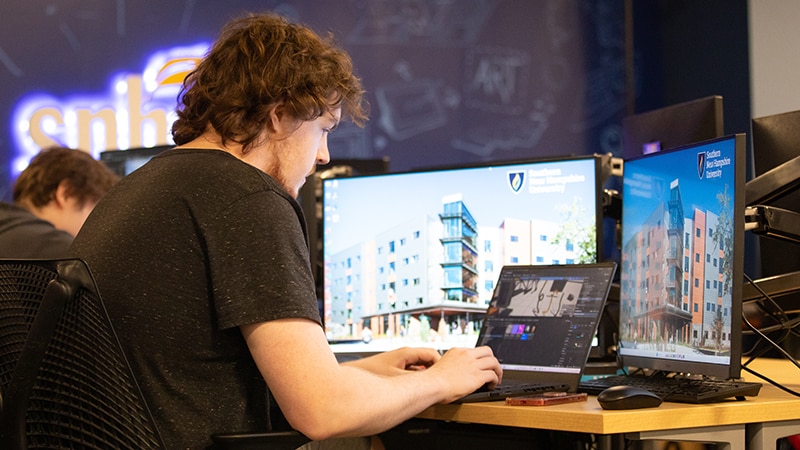
The game design and development curriculum combines technical instruction with creativity and teamwork. You’ll start by exploring the 3 key pillars of the game industry — design, art and development — building a strong foundation in game mechanics and interactive storytelling. Then, you’ll dive into projects that mirror the real-world production cycle of game development, using industry-standard tools and processes to design, prototype and test your own games.
Campus game design and development concentrations
In this program, you'll choose a concentration that matches your interests and career goals. Each concentration provides hands-on, specialized training to help you master the specific skills employers in the gaming industry are looking for.
In the game art concentration, you’ll specialize in making artwork for video games. With a focus on the visual side of game creation — everything players see and interact with — you'll learn digital sculpting, 3D modeling and environmental design. You'll bring worlds and characters to life by building immersive, industry-ready assets. From crafting the leading heroine in an action adventure game to designing a steampunk cityscape for an RPG, or collectible coins in a mobile puzzle game, you’ll develop the artistic skills to make your creative vision a playable reality.
Game programmers are the scientists of game design. In the game programming concentration you'll study the systems that power gameplay. Using languages like C++, C# and Java, you'll learn coding and scripting skills needed to build the systems and gameplay mechanics behind interactive experiences. This concentration prepares you for specialized roles such as gameplay programmer, tools developer or simulation engineer — where you’ll be the one making games run smoothly across platforms.
In the game design concentration, you’ll learn to balance creativity and strategy to craft immersive, player-centered experiences. You'll develop a deep understanding of the game industry and what gamers want as you learn to shape how players experience the game world through storytelling, user experience and narrative structure. Game designers may specialize in a particular area of a game, such as a content designer who creates names, dialogue, quests and stories, or a level designer who develops blueprints of level maps.
Learn from Instructors with industry experience
Our faculty members bring with them decades of experience, which informs the development of SNHU’s courses and curriculum. They look forward to supporting your journey in the classroom and as you work toward a career in game design and development.
Featured Faculty
Edward Brillant

Position
Instructor and Chair, Game Art and Interactive Design
Joined SNHU
2012
Education
- BFA in Illustration from Montserrat College of Art
Edward Brillant brings over 15 years of experience in the 3D industry, most recently serving as art director at Seven45 Studios in Boston. He's contributed to 9 published games across platforms like iPhone, iPad, PC, Xbox 360 and PS3. Beyond gaming, Edward has worked in children's television, serving as lead animator for "A Very Wompkee Christmas," which aired on ABC and PBS.
Campus major courses
You’ll take major courses that provide you with a solid foundation in your area of study – in some cases featuring experiential or project-based learning opportunities, labs, simulations and internships. These courses will allow you to learn a wide variety of topics and help prepare you for a role in your desired field.
Courses may include:
Visit the course catalog to view the full BS in Game Design and Development curriculum.
Campus general education courses
All undergraduate students are required to take general education courses, which are part of SNHU's newly redesigned program, The Commons. The goal of The Commons' curriculum is to empower you with some of the most in-demand skills, so you can succeed not only in your academic career, but in your personal and professional life too.
Courses may include:
Can’t wait? You don’t have to!
Apply now if you’re ready, and have your decision within 30 days. Or, schedule a visit and come see us in person!
Have questions? Visit our Contact Us page.
Career Outlook What can I do with a game design and development degree?
The global video game industry is one of the fastest-growing entertainment markets, with an increasing demand for skilled designers, artists and developers. A degree in game design and development can open doors to exciting job roles with studios, tech companies or digital media organizations. You’ll graduate ready to apply your creativity, technical ability and problem-solving skills in a wide range of digital media and interactive entertainment careers.
Career paths include:
- Game designer
- Design director
- Level designer
- Programmer
- Multimedia producer
- Animator
- Digital Artist

Median annual wage nationally for web and digital interface designers in May 2024, according to the U.S. Bureau of Labor Statistics (BLS).1
Median annual wage nationally for special effects artists and animators in May 2024, according to the BLS.1
Understanding the numbers
When reviewing job growth and salary information, it’s important to remember that actual numbers can vary due to many different factors—like years of experience in the role, industry of employment, geographic location, worker skill and economic conditions. Cited projections are based on Bureau of Labor Statistics data, not on SNHU graduate outcomes, and do not guarantee actual salary or job growth.
Campus Student Experience So, what’s it like taking classes on campus?
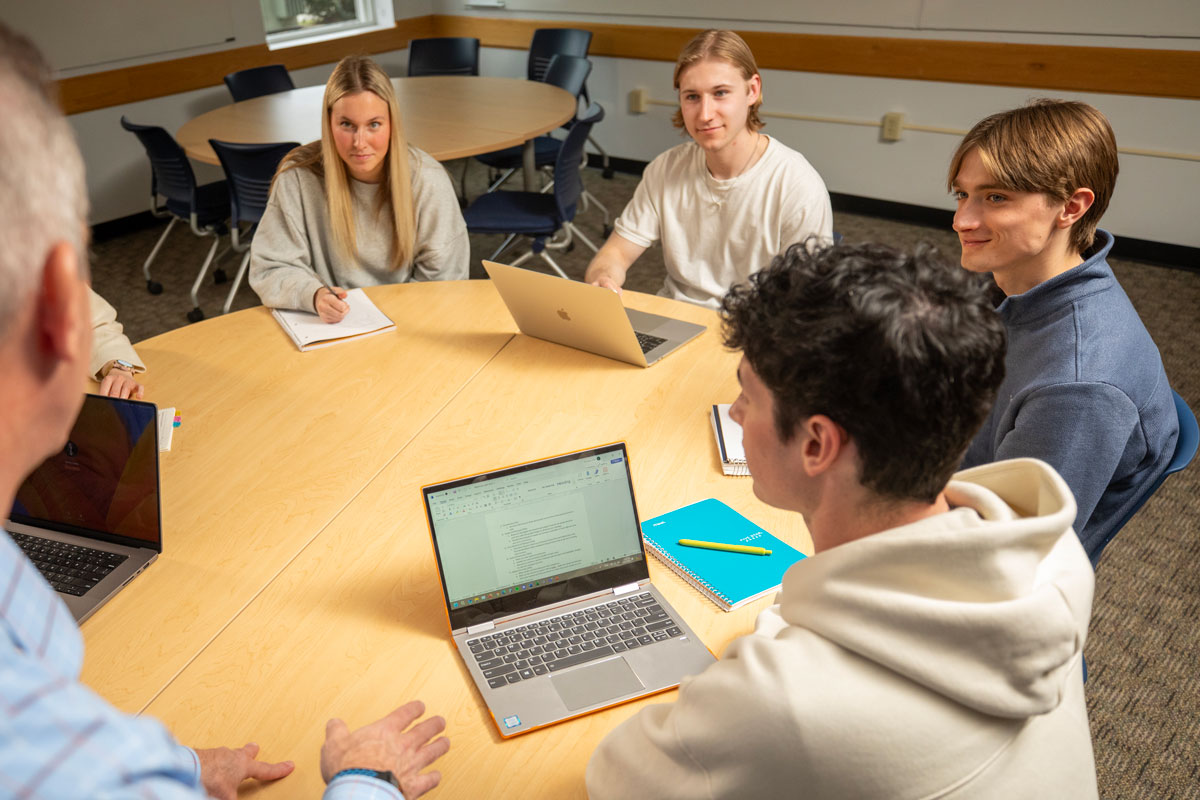
On campus at SNHU, you’ll work closely with your classmates on team projects, share feedback and experiment with new ideas. Whether you’re brainstorming mechanics in a studio course or testing your prototype in a collaborative space, you’ll gain the real-world experience and teamwork skills that make you stand out to future employers, all while building lasting connections with peers and mentors who share your passion for gaming.

Student support
At SNHU, you don’t have to do this college thing alone. You’ll have help from your advisor, access to tutoring and office hours, career coaching, and mental health services so you can do your best and feel your best.
Additionally, our Office of Diversity and Campus Accessibility Center make campus a safe place for everyone. Visit our Student Services page to learn more about our support offerings.

Small class sizes
With an average class size of 15-25 (depending on your major) you’ll learn in an environment where professors with real world experience know you by name.
Here, you’re not getting lost in giant lecture halls, but instead, actively participating in thoughtful dialogue where you’re always encouraged to collaborate with your peers and ask questions when they arise.
State-of-the-art facilities
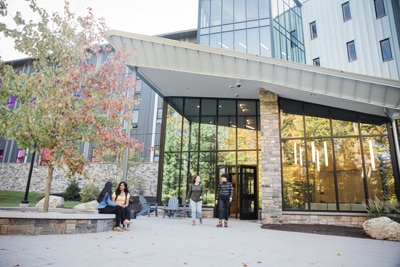
Our 300-acre campus has everything you need. From technology-advanced classroom settings to your dorms complete with fitness centers and hangout spots, our goal is to give you the best college experience possible.
Whether you’re learning in a classroom, in a lab, on the field, or in your field, you’ll have what you need to be successful from the moment you wake up to the moment you close your textbooks.

School of Arts, Sciences and Education Learn about the School of Arts, Sciences and Education
From understanding why people behave the way they do, to studying and tackling today's environmental issues, the School of Arts, Sciences and Education serves as an academic hub for creativity, collaboration and learning. Here, you'll have the chance to gain real-world experience through internships, student teaching, lab work and community-based projects. From studying cells under a microscope or analyzing crime scenes to leading a student-teaching session in an elementary classroom, you’ll learn how the world works so you can help make it a better place.
Student teaching opportunities
Inkwell game design studio
State-of-the-art labs
How SNHU makes college affordable
At Southern New Hampshire University, we're on a mission to make high-quality education more accessible with more affordable tuition. With 70+ career-focused majors, state-of-the-art facilities, D2 sports and over 70 student clubs and organizations, you can get the campus experience you've always dreamed of at a more affordable price.
Fill out the FAFSA to see if you’re eligible for grants or work-study. (You could also be offered loans, though you’ll have to pay those back later.)
Transfer up to 90 credits toward your bachelor's degree program at SNHU. If you’ve taken one course or many, we’ll evaluate them for you.
Getting free money for college – from SNHU or an outside organization – could help you save hundreds or even thousands of dollars.
Our collaborative partnerships with high schools enhance academic opportunities and college accessibility for some high school students.
Accreditations
SNHU is accredited by the institutional accreditor the New England Commission of Higher Education (NECHE). The university also carries specialized accreditations for some programs.

Sources & Citations
1Bureau of Labor Statistics, U.S. Department of Labor, Occupational Outlook Handbook, on the internet, at:
- https://www.bls.gov/ooh/computer-and-information-technology/web-developers.htm (viewed Nov. 12, 2025)
- https://www.bls.gov/ooh/arts-and-design/multimedia-artists-and-animators.htm (viewed Nov. 12, 2025)
Cited projections may not reflect local and/or short-term economic or job conditions and do not guarantee actual job growth.
Your dream school is waiting
Apply now or schedule a visit today.